YouTube's Second-Screen Era: Your Thumbnail Now Has Two Jobs
Two-thirds of viewers watch YouTube while scrolling a phone, and 44% of watch time is now on TV. Design thumbnails that win a half-watching audience.
Here is a scene that plays out millions of times every evening in 2026. Someone is on the couch. YouTube is playing on the TV. And their eyes are not on the TV — they are on the phone in their hand, half-scrolling a feed, glancing up only when the audio changes pitch or a thumbnail in the up-next column catches their peripheral vision.
That viewer is not paying you full attention. They are paying you a fraction of it, split across two screens — the second-screen behavior that now defines how most people watch YouTube. And the way most creators design thumbnails assumes the opposite: a viewer leaning in, scanning carefully, ready to be persuaded. That assumption is now wrong most of the time, and it is quietly capping your reach.
I have been watching this shift land in our community's analytics for the past few months, and the pattern is consistent. The thumbnail's job description changed when YouTube became a living-room platform with a distracted audience. It now has two jobs instead of one — and most thumbnails are still only doing the first.
The Platform Moved to the Living Room, and the Viewer Brought a Phone
Start with the structural change. YouTube is no longer primarily a phone app you open on the subway. Connected TVs now account for over 44% of YouTube watch time in the U.S. in 2026, up from about 41% in 2022, according to eMarketer data. The TV screen has become the single biggest device for YouTube viewing in the United States, surpassing mobile.
The scale here is hard to overstate. YouTube streams more than 1 billion hours of content on TVs every single day, and it holds the largest share of all U.S. TV viewing of any media company — around 12.5%, ahead of Netflix and Disney. By Nielsen's measure, YouTube has been America's number-one streamer for 12 straight months.
Now layer the behavioral change on top. People do not watch the big screen the way they watch a phone. Two-thirds of U.S. viewers will watch TV with a second screen in 2026, per MNTN research — and a separate MNTN survey found that 74.2% of Americans use another device while watching TV. Gen Z and millennials, the analysts note, have become "radical multitaskers" who effectively stretch the day by running two screens at once.
The ad industry has been measuring exactly how much attention this costs. In a year-long eye-tracking study released in February 2026, VAB and TVision found that premium streaming platforms keep viewers' eyes on the screen longer than YouTube does — what the report calls an "impression gap." The same data showed premium video sees about 33% more co-viewing than YouTube. The takeaway for advertisers was about ad recall. The takeaway for creators is bigger: the living-room YouTube viewer is, on average, only partly present.
So your thumbnail is no longer competing for a focused scan. It is competing for the two seconds when a half-watching person glances up from their phone.
Your Thumbnail's Two New Jobs
When attention is whole, a thumbnail has one job: be the most clickable tile in the grid. When attention is split, that job forks in two.
Job one: survive a peripheral-vision glance, not a careful scan. On a phone, a viewer scrolls deliberately and reads. On a TV with a phone in hand, the TV image lives in peripheral vision until something pulls the eye up. Peripheral vision is bad at detail and good at contrast, motion, and faces. A thumbnail that depends on three lines of small text or a subtle expression simply will not register — the viewer never looks up for it. This is why the neo-minimalist trend toward one dominant subject and minimal text is not just an aesthetic preference. It is an adaptation to an audience that has to be interrupted before it can be persuaded.
Job two: re-capture a viewer who already drifted. This is the genuinely new job. In single-screen viewing, you win the click and you are done. In split-screen viewing, the viewer often clicks, then looks back down at the phone within seconds, then has to be pulled back up by your next surface — the end screen, the up-next column, the chapter thumbnails. Your packaging now has to keep re-earning the glance throughout the session, not just win it once at the start.
Most creators optimize obsessively for job one and never think about job two. That is the gap I want to help you close.
Stop guessing. Start testing thumbnails.
Paste any YouTube URL and get AI-branded thumbnails in under 60 seconds. Free to try.
Try Hooksnap FreeThe Cross-Surface Problem: One Image, Two Very Different Screens
Here is a trap I see constantly. A creator designs a thumbnail that looks incredible on the 65-inch TV up-next column — cinematic, detailed, rich. Then the same image gets served to that viewer's phone, where the YouTube app is acting as the remote, and it is now a postage stamp surrounded by other tiles. The detail that sold it on TV is invisible at phone scale.
The reverse trap is just as common: a punchy, text-heavy mobile thumbnail that wins on the phone looks crude and cluttered blown up on a living-room display, where compression artifacts and oversized type read as cheap. (If your thumbnails are visibly degrading on big screens, the technical fixes — file size, resolution, the new 50MB ceiling — are worth a dedicated read; I covered the pixel-level side of this in designing thumbnails for TV screens.)
The strategic point is that you are now designing one image that has to clear two thresholds at once:
- The 10-foot threshold: legible and compelling from across a room, navigated by a remote.
- The 6-inch threshold: legible and compelling as a thumb-sized tile on the phone that is acting as the remote and the second screen.
The composition that satisfies both is the same one the data keeps pointing to: a single dominant subject filling 30 to 50% of the frame, two to four high-contrast words at most, and a clear focal hierarchy with no competing centers of interest. Research into 2026 thumbnail patterns found that 67% of trend guidance focuses on layout and structure, while only a third mentions dominant color — structure scales across screen sizes in a way that a clever palette does not. A clean, structured thumbnail is not just on-trend. It is the only design that survives being shrunk to phone scale and stretched to TV scale from the same source file.
The practical test: shrink your thumbnail to roughly 120 pixels wide and look at it from arm's length, then view it full-screen on the largest display you own. If the core message — subject, emotion, the one idea — survives both, you have a cross-surface thumbnail. If it only works at one size, you are leaving the other half of your audience behind.
TV Companion and "Ask": The Phone Is Now Part of the Watch
The second-screen problem used to be passive — the viewer drifted to the phone on their own. In 2026, YouTube is actively building features that send them there on purpose, and creators need to understand what that does to packaging.
In May 2026, YouTube rolled an "Ask" button into the TV viewing experience: while watching, a viewer can press a microphone button on the remote or tap an Ask icon to query the video with conversational AI — pulling up specific facts, like the benchmark scores mentioned in a phone review, without pausing. Alongside it, YouTube has been building a TV Companion experience that lets viewers interact with what is on the TV from their phone, and a wave of "living room" job postings points to more interactivity — chatting, gifting, multi-device controls — coming to the big screen.
Tubefilter framed this as YouTube's answer to "Netflix's second-screen problem": instead of fighting the phone, YouTube is trying to fold the phone into the watch. That is clever for engagement. For creators, it means two things:
- The phone is no longer a competitor you lose the viewer to — it is a surface you can be pulled into. When a viewer asks the TV a question and the answer lands on their phone, your up-next thumbnails are right there in the same session. The split-attention moment becomes a discovery moment if your packaging is ready for it.
- Mid-video drift is now an explicit product behavior, not an accident. Which makes job two — re-capturing a drifted viewer — a design requirement, not a nicety. Your end screen and up-next packaging are the recapture surface, and they are doing more work than ever.
I would not over-rotate on TV Companion specifically; it is a limited rollout in select languages today. But the direction is unambiguous, and it confirms the broader thesis: YouTube is designing for a split-attention viewer, so you should be too.
What to Actually Change This Week
Strategy is only useful if it changes what you do on the next upload. Here is the concrete checklist I would run.
1. Re-test every thumbnail at two extremes, not one. Stop checking your thumbnail only in YouTube Studio at full size. View it at ~120px (phone-tile scale) and full-screen on a TV. Most creators have never done the second test, and it is where the cross-surface failures hide. You can run a fast first pass with a free thumbnail checker before you commit.
2. Cut to one subject and three words. If your thumbnail has more than one focal point or more than three or four words, it is built for a focused scan, not a peripheral glance. The fix the trend research keeps recommending is brutal but effective: take everything out except one subject and resize it to fill 30 to 50% of the frame.
3. Design your end screen and up-next packaging as a recapture system, not an afterthought. The thumbnail that wins the first click and the thumbnails that re-earn attention mid-session are the same packaging job. Build them as a set with consistent visual grammar so a drifting viewer recognizes "more of this" at a glance. I broke down the mechanics of this in the end-screen design system.
4. Make the thumbnail and the title carry the message independently. A half-watching viewer might read the title (audio cue, or it is closer to the phone) without ever studying the image, or glance at the image without reading the title. Each has to deliver the hook alone — they cannot depend on each other. This is the title-and-thumbnail-as-one-unit principle, made more urgent by split attention.
5. Match the promise to the watch, because the satisfaction algorithm is watching too. A second-screen viewer who clicks on a misleading thumbnail does not lean in to forgive you — they glance up, feel the mismatch, and drift back to the phone for good. In a satisfaction-driven ranking system, that drift is a negative signal. Honest, structured packaging is not just nicer; it is the only kind that survives a distracted audience.
The Bigger Picture: Designing for Partial Attention Is the New Default
For most of YouTube's history, the implicit design brief was "win a focused viewer's scan." That brief produced a decade of escalating thumbnails — louder colors, bigger faces, more shock — all premised on a viewer leaning in.
The 2026 brief is different. The platform's center of gravity moved to the living room, the audience brought a second screen, and the reaction against over-polished, attention-grabbing imagery means louder is no longer automatically better. The winning thumbnail is now the one that survives a peripheral glance, scales cleanly across a 6-inch and a 65-inch screen, and re-earns attention across a whole viewing session — not just at the first impression.
That is a real design problem, and it is harder to solve manually for every upload, especially when you need consistent packaging across the first thumbnail, the up-next tiles, and the end screen. It is exactly the problem we built Hooksnap to solve: generate structured, on-brand thumbnail packaging that holds up across surfaces and stays coherent as a set, so a distracted viewer keeps recognizing your content no matter which screen they glance at. You can start free and run your next idea through it before you film.
The viewer changed. Your thumbnail's job changed with them. The creators who notice first — and design for partial attention instead of fighting it — are the ones who will keep winning the glance in the second-screen era.
See how Hooksnap creates click-worthy thumbnails
AI-powered thumbnail generation that helps your YouTube videos get more clicks.
View PlansRelated Articles
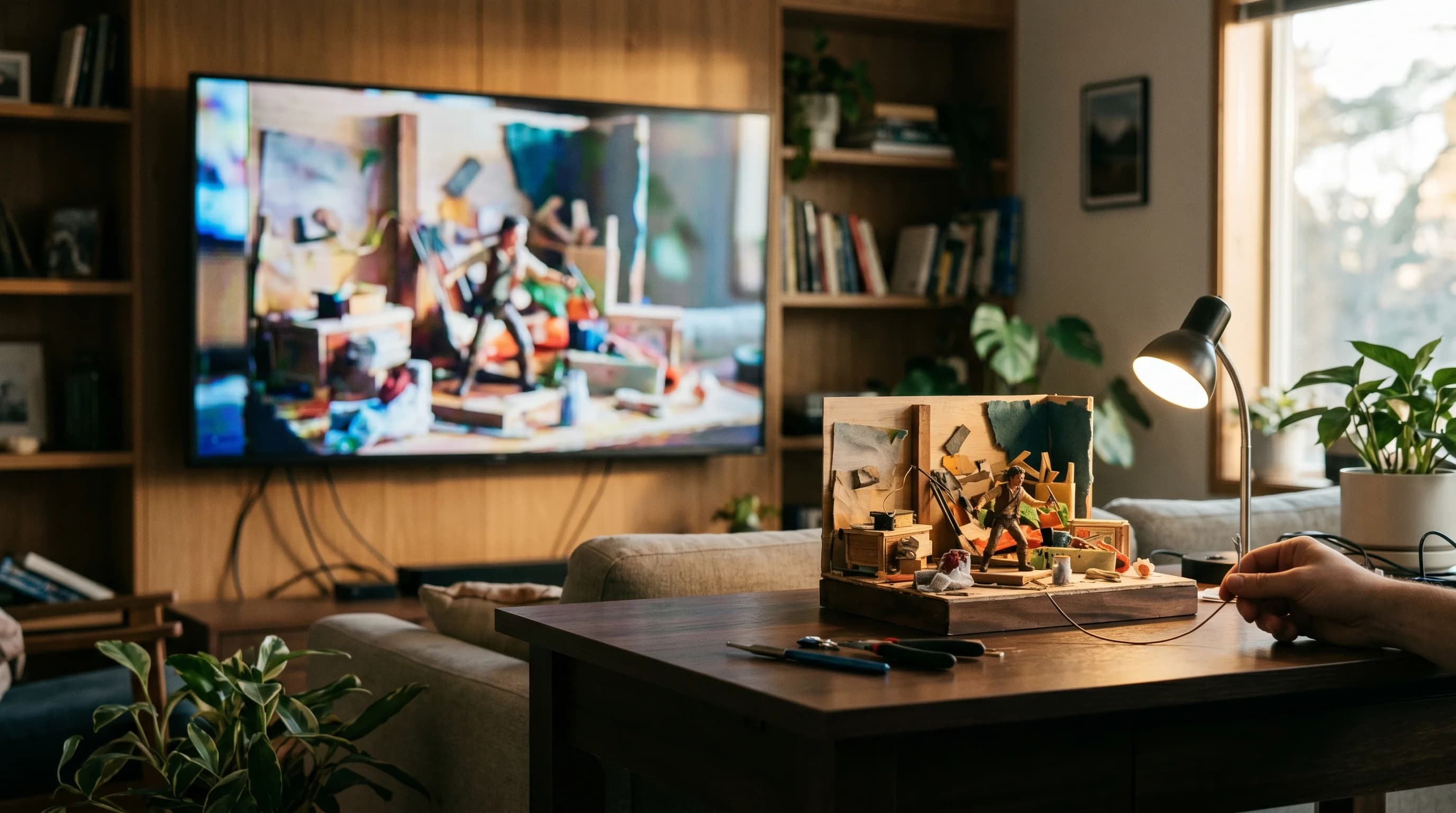
YouTube Thumbnails for TV Screens: Designing for the Living Room
1 billion hours of YouTube are watched on TVs daily. Design thumbnails that look sharp on 65-inch screens and win clicks from the couch.
YouTube's Satisfaction Era: Your Thumbnail Is a Viewer Contract
YouTube's 2026 algorithm prioritizes viewer satisfaction over clicks. Here's how this shift turns your thumbnail into a contract you must deliver on fast.
YouTube End Screen Design 2026: Doubling Session Watch Time
End screens are YouTube's most underused growth lever. The 2026 system for end screens and next-video thumbnails that double session watch time.
Related Tools
Ready to boost your CTR?
Stop losing clicks to boring thumbnails. Get AI-generated thumbnails in under 60 seconds.
Get Started Free