YouTube's Satisfaction Era: Your Thumbnail Is a Viewer Contract
YouTube's 2026 algorithm prioritizes viewer satisfaction over clicks. Here's how this shift turns your thumbnail into a contract you must deliver on fast.
Something shifted on YouTube in 2026, and most creators haven't caught on yet.
For years, the playbook was simple: make a thumbnail that gets clicks, keep people watching as long as possible, repeat. CTR and watch time were the twin gods of the algorithm. But YouTube has been quietly rebuilding the machine that decides who gets recommended — and the new model doesn't care how many clicks you get if viewers leave feeling cheated.
The platform now runs millions of post-watch satisfaction surveys asking viewers a simple question: "Was this video worth your time?" Those survey responses, combined with behavioral signals like shares, repeat views, and whether someone keeps browsing YouTube after your video, now carry more weight than raw watch time in the recommendation engine.
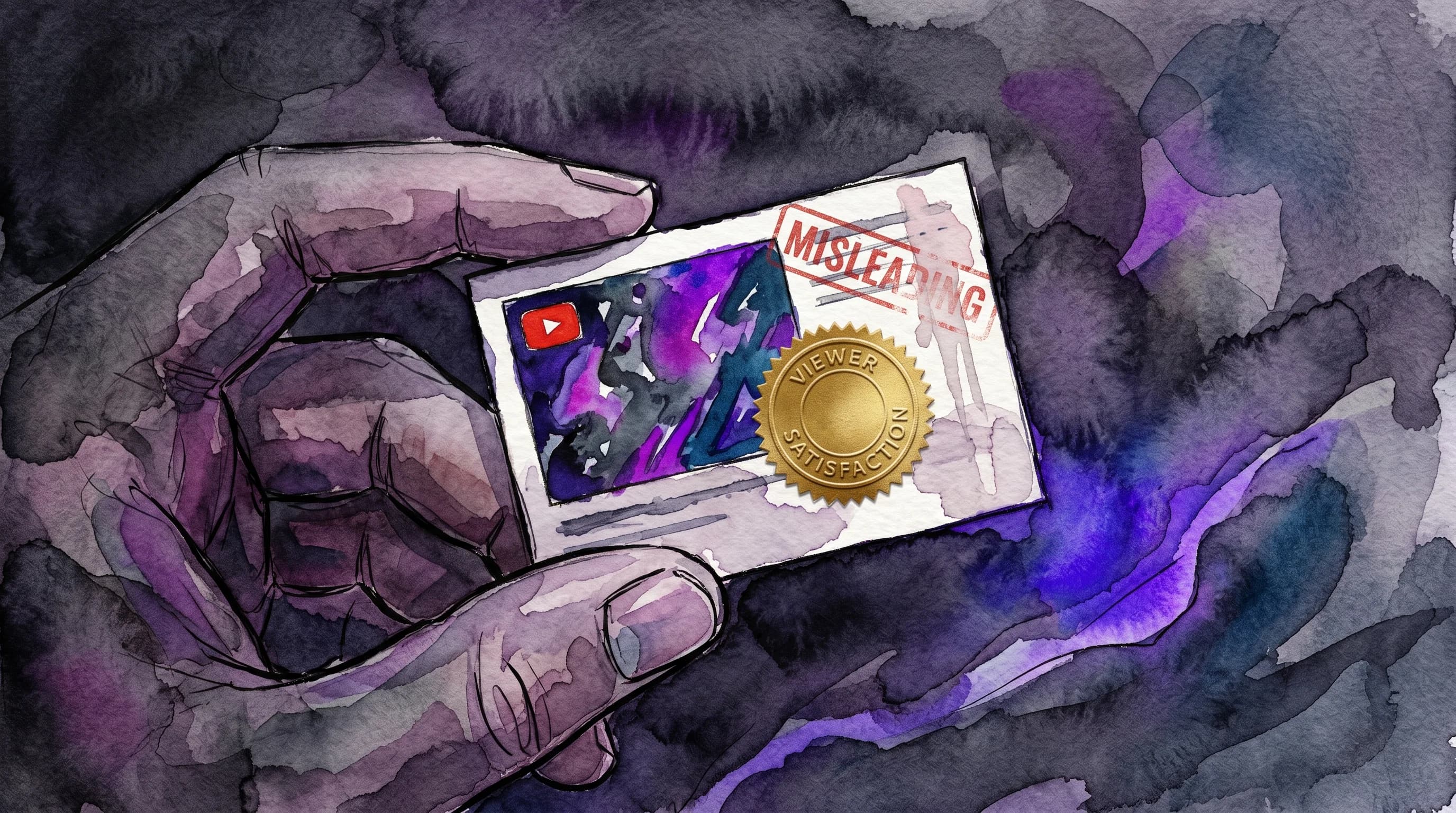
This changes everything about how you should think about thumbnails. Your thumbnail isn't a billboard anymore. It's a contract.
The Satisfaction Model: What Actually Changed
YouTube's algorithm has always used multiple signals, but the hierarchy has flipped. In previous years, a video that generated a high CTR plus long watch time would dominate recommendations regardless of whether viewers actually enjoyed the experience. A creator could use a sensational thumbnail, deliver mediocre content, and still ride the algorithm because the numbers looked right on paper.
The 2026 model works differently. YouTube now uses what they call "satisfaction-weighted discovery," where a 3-minute video that gets shared beats a 20-minute video that gets abandoned. The platform confirmed that shorter videos with high retention now outperform longer videos with low retention — a reversal of the old "longer is better" conventional wisdom.
Here's how the new signals stack up:
- Post-watch surveys: YouTube asks a sample of viewers whether the video was helpful, enjoyable, or worth their time. These responses directly influence how aggressively the video gets recommended.
- Share signals: A share — especially off-platform to WhatsApp or Discord — is now one of the strongest quality signals YouTube tracks. People don't share content that disappointed them.
- Session contribution: Videos that lead viewers to watch more content afterward get significantly more suggested placements. If your video is a dead end (viewer closes the app), the algorithm notices.
- Repeat views: When someone re-watches your video or comes back to your channel, YouTube reads that as genuine satisfaction, not just passive consumption.
The old game rewarded optimizing for initial clicks. The new game rewards optimizing for post-watch feelings. And that distinction matters more than most creators realize.
Why Misleading Thumbnails Now Actively Hurt You
Under the old model, a misleading thumbnail was a calculated trade-off. You might lose some retention, but the CTR boost could still net you more total views. That math no longer works.
Misleading thumbnails now cause a 40% audience loss in the first 30 seconds, according to data from multiple thumbnail testing platforms. Under the satisfaction model, that massive drop-off doesn't just reduce your video's performance — it tells the algorithm that your content failed to deliver on its promise. YouTube then suppresses the video in recommendations, and worse, it adjusts its confidence in your channel for future uploads.
Think of it like a restaurant. If you put a photo of a gourmet steak on your menu but serve a microwave dinner, customers don't just leave — they stop trusting your entire menu. YouTube's algorithm works the same way now. A pattern of promise-delivery mismatch trains the system to reduce your reach across all your content.
YouTube has also tightened its policies around deceptive thumbnails, with repeated violations potentially resulting in content removal or channel strikes. But the algorithmic penalty is arguably worse than any policy strike: your videos simply stop being shown to new viewers.
The Thumbnail-as-Contract Framework
If thumbnails are contracts, what does a good contract look like? It comes down to three principles:
1. Make a Specific Promise
Vague thumbnails produce vague expectations, which makes it almost impossible to satisfy viewers. The most effective thumbnails in the satisfaction era make a clear, specific promise that the video can actually deliver on.
Compare these two approaches for a cooking video:
- Vague: A photo of a kitchen with the text "COOKING HACK"
- Specific: A before/after showing raw ingredients and a finished dish with the text "$3 MEAL"
The specific version sets a concrete expectation. The viewer clicks knowing exactly what they'll get. When the video delivers that $3 meal, the contract is fulfilled, the viewer feels satisfied, and the algorithm rewards the video.
The data supports this. Channels using what thumbnail testing platforms call the "hero-object approach" — one large, specific object as the primary storytelling element — consistently outperform busy, multi-element thumbnails. Simplicity creates clarity, and clarity creates accurate expectations.
2. Front-Load the Payoff
The satisfaction model puts enormous weight on the first 30 seconds. YouTube tracks whether your opening content matches the thumbnail promise, and creators who align these two elements see retention jump by up to 15%.
This means your thumbnail and opening sequence need to be designed as a single unit. If your thumbnail shows a dramatic before/after transformation, the video should show that transformation setup within the first 15 seconds — not buried at the 8-minute mark behind a lengthy intro.
The concept of "Time to Value" (TTV) has become a core metric. Deliver the promised value as fast as possible. A viewer who gets what they came for in the first minute will stay for the bonus content. A viewer who's still waiting at minute three will leave and never come back.
Stop guessing. Start testing thumbnails.
Paste any YouTube URL and get AI-branded thumbnails in under 60 seconds. Free to try.
Try Hooksnap Free3. Under-Promise, Over-Deliver
This might sound counterintuitive for thumbnails, but the satisfaction model actually rewards restraint. A thumbnail that promises "5 Tips" but delivers 7 useful tips creates a positive surprise. A thumbnail that implies a mind-blowing revelation but delivers common knowledge creates disappointment.
The math is simple: viewer satisfaction = actual value minus expected value. You control the "expected value" side of that equation through your thumbnail and title. Set expectations you can consistently exceed, and the algorithm will compound your reach over time.
Designing Thumbnails for Satisfaction: A Practical Checklist
Here's the framework I use when creating thumbnails at Hooksnap and for my own content:
Before designing:
- Write down the single most valuable thing in your video
- Ask yourself: "If someone clicks based on this promise, will they feel their time was well spent after watching?"
- If the answer is uncertain, adjust the promise — not the content
During design:
- Limit text to 1-3 words maximum — the 2026 trend is toward fewer words with bolder fonts for instant mobile readability
- Use one focal point that communicates the specific promise
- Match the emotional tone of the thumbnail to the actual video content (don't use shocked faces for calm tutorials)
- Test at mobile size — over 70% of YouTube watch time happens on mobile where tiny thumbnails need to communicate instantly
After publishing:
- Check your retention graph at the 30-second mark. A steep drop there indicates a thumbnail-content mismatch
- Monitor your satisfaction signals: shares, playlist adds, and whether viewers continue to browse your channel
- Use YouTube's built-in Test & Compare feature to A/B test variants — top channels now test 3 or more thumbnail variants per video
The Satisfaction Flywheel: How This Compounds
The real power of satisfaction-optimized thumbnails isn't in any single video — it's in the compounding effect across your channel.
YouTube's system now tracks channel-level satisfaction patterns. When your videos consistently deliver on their thumbnail promises, the algorithm develops higher confidence in recommending your future content. You get shown to more new viewers, those viewers arrive with accurate expectations, they leave satisfied, and the cycle reinforces itself.
This is the opposite of the old clickbait flywheel, where increasingly sensational thumbnails led to diminishing returns as the algorithm learned your content disappointed viewers. The satisfaction flywheel rewards consistency and honesty with exponentially growing distribution.
Consider the numbers: with over 69 million active creators and 500+ hours of content uploaded every minute, YouTube's algorithm needs efficient ways to sort signal from noise. Viewer satisfaction is that signal. A channel with a 90% satisfaction rate and moderate CTR will outperform a channel with high CTR and 60% satisfaction — because the algorithm knows which channel's recommendations will keep viewers on the platform.
What This Means for Different Niches
The satisfaction shift affects every niche, but the practical implications vary:
Gaming creators: Gameplay thumbnails showing an epic moment need to deliver that moment early. The old trick of using a thumbnail moment from the 15-minute mark doesn't work when viewers expect immediate payoff. Consider showing the setup in the thumbnail and delivering the payoff in the first 30 seconds.
Educational channels: "How-to" thumbnails should accurately represent the complexity level. A thumbnail showing a simple 3-step process shouldn't lead to a 45-minute deep dive — unless you signal that depth upfront. Viewers want to know what they're committing to. Check out our guide for educators for niche-specific tips.
Tech reviewers: Product thumbnails with dramatic reactions ("I can't believe this!") set expectations for genuine surprise. If the product is solid but unremarkable, a calmer thumbnail that promises an honest take will score higher in satisfaction. See how leading tech creators approach this in our comparison with other thumbnail tools.
Vlog creators: Emotional thumbnails need to match emotional content. A thumbnail showing tears should lead to a genuinely emotional moment, not a clickbait setup with a "gotcha" explanation at minute two.
The Role of AI in Satisfaction-First Thumbnails
Here's where I'll be transparent about what we're building at Hooksnap. The satisfaction model creates a design challenge that AI can actually help solve — not by generating more sensational images, but by helping creators maintain consistency between their thumbnail promise and video content.
When you upload a video to Hooksnap, the system analyzes your actual video content before generating thumbnail options. This means the thumbnails are designed around what your video actually delivers, not around what might theoretically get the most clicks. That alignment between promise and delivery is exactly what the satisfaction algorithm rewards.
Tools like A/B testing — whether through YouTube's native Test & Compare or through dedicated platforms — also become more important in the satisfaction era. But the goal of testing shifts: instead of optimizing purely for CTR, you're optimizing for the combination of CTR and post-click satisfaction. A thumbnail with a slightly lower CTR but much higher retention and satisfaction will outperform the high-CTR alternative over time.
If you're currently relying on generic templates or stock-style thumbnails that don't connect to your specific content, the satisfaction model penalizes that disconnect. Every thumbnail needs to be an accurate preview of the specific video it represents. Tools that understand your content context — like AI-powered thumbnail generators — make that standard achievable at scale without spending hours in Photoshop for each upload.
Measuring Whether Your Thumbnails Pass the Satisfaction Test
You don't need YouTube to release an official "satisfaction score" to track this. Here are the proxy metrics that correlate with satisfaction:
-
30-second retention rate: If more than 40% of viewers drop off before the 30-second mark, your thumbnail is likely overpromising. This is the single most important metric for thumbnail-content alignment.
-
Share rate: Track how many shares your videos get relative to views. Satisfied viewers share; disappointed viewers don't.
-
New vs. returning viewer ratio: A healthy channel in the satisfaction era should see returning viewers growing. If you're constantly attracting new viewers who never come back, your thumbnails might be bringing in the wrong audience.
-
Average CTR trajectory over time: Under the satisfaction model, your CTR should be stable or gradually increasing as the algorithm shows your videos to better-matched audiences. Declining CTR across videos suggests the algorithm is losing confidence in your thumbnail-content match.
-
End screen click-through: If viewers reach your end screen and click to another video, that's a strong signal they were satisfied with the first one. Low end-screen engagement despite decent watch time might indicate passive viewing rather than active satisfaction.
The Bottom Line
The shift from clicks-and-watch-time to viewer satisfaction isn't a minor algorithm tweak. It's a fundamental change in what YouTube rewards, and it requires a matching shift in how creators think about thumbnails.
Your thumbnail is no longer just a marketing asset. It's the first line of a promise your video needs to keep. Design it honestly, deliver on it quickly, and the algorithm will do the rest.
The creators who figure this out first — who stop optimizing for maximum clicks and start optimizing for maximum satisfaction — will own the next wave of YouTube growth. Everyone else will wonder why their CTR looks fine but their views keep declining.
Start by auditing your last 10 thumbnails. For each one, ask: "Does my video deliver exactly what this thumbnail promises, within the first 30 seconds?" If the answer isn't a clear yes, you've found your biggest growth opportunity.
And if you want to test this approach without redesigning every thumbnail manually, give Hooksnap a try — we built it specifically to create thumbnails that match your actual video content, which is exactly what the satisfaction era demands.
See how Hooksnap creates click-worthy thumbnails
AI-powered thumbnail generation that helps your YouTube videos get more clicks.
View PlansRelated Tools
Ready to boost your CTR?
Stop losing clicks to boring thumbnails. Get AI-generated thumbnails in under 60 seconds.
Get Started Free