YouTube Killed the Subscriber Bell: Thumbnail Strategy 2026
YouTube made bell-notification filtering permanent in April 2026. Inactive subscribers no longer get push alerts. Your thumbnail is the new subscriber reach.
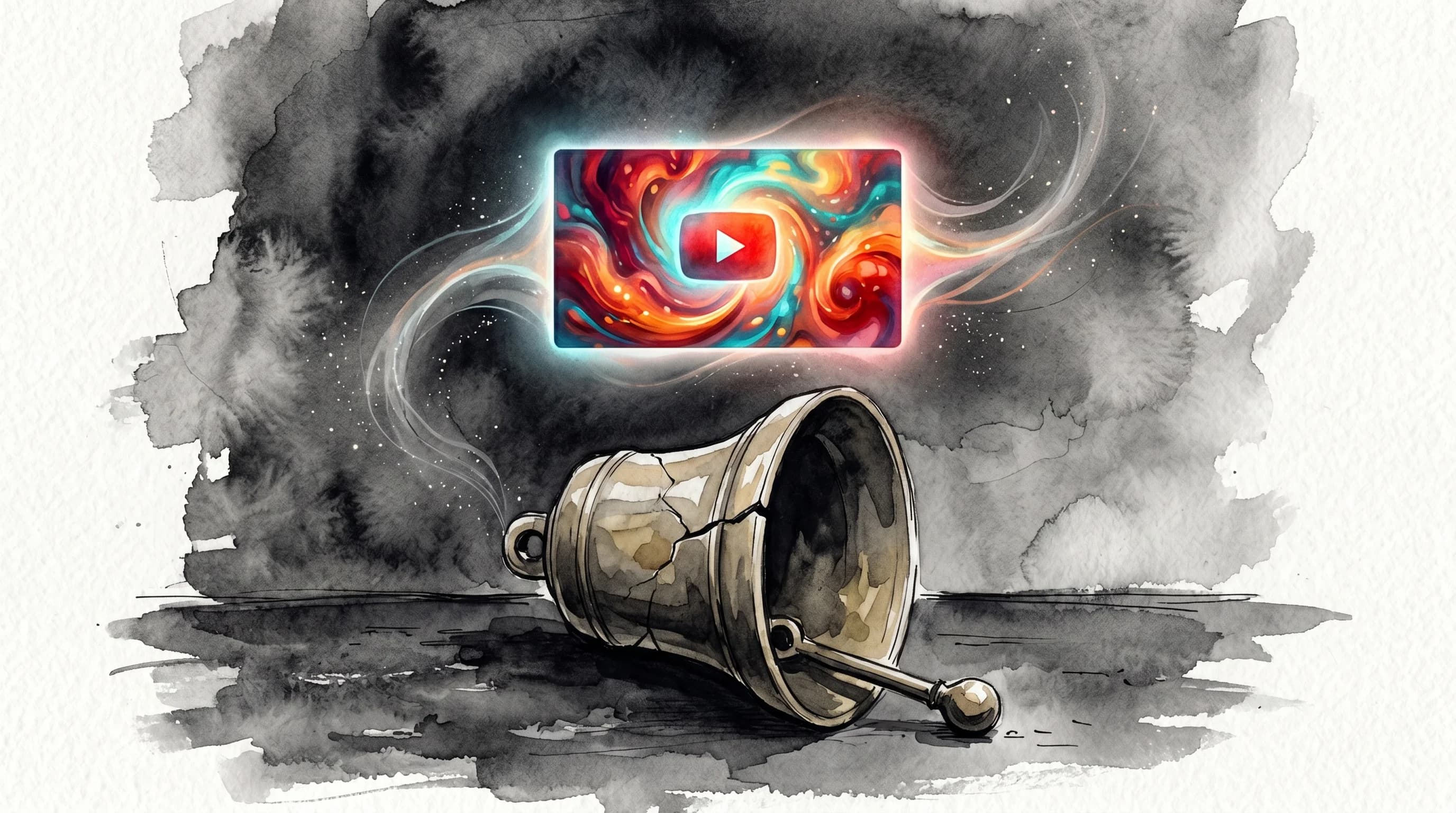
On April 21, 2026, a TeamYouTube post quietly ended a decade of creator advice. "Click the bell to never miss an upload" — the line every creator has scripted into outros since 2017 — is no longer guaranteed. YouTube made permanent the experiment that filters push notifications away from "inactive All subscribers," and the implication for thumbnail strategy is bigger than most creators realize.
I run an AI thumbnail tool (Hooksnap), so I track every change YouTube makes to how subscribers find new uploads. This one matters because it shifts where your loyal audience actually sees your next video — and the design rules for the new location are different from the old one.
Here is what changed, why it matters, and what to do about it.
Quick Answer
YouTube now permanently filters mobile push notifications for subscribers who hit "All" but haven't watched the channel in roughly 30 days. Those subscribers will still see your uploads in the Subscriptions feed and in-app inbox — push delivery to the device stops. For thumbnails, this means your subscriber reach now depends on competing visually against every other channel they follow inside the feed, not on owning the entire lock screen for a few seconds. Bold, isolated subject thumbnails designed for push (small, OS-level) lose to thumbnails designed for feed competition (legible at 120px wide, distinct from neighbors, and clearly grounded in the video). Multi-variant testing matters more, not less.
What YouTube Actually Changed About the Subscriber Bell
The change was announced by Dave from TeamYouTube and made permanent on April 21, 2026 after experimenting since March 2025. The full mechanic:
- A subscriber selects "All" notifications on your channel.
- YouTube tracks whether they've actually watched anything from you in approximately the last month, and whether they've ignored recent push notifications from you.
- If both signals say "inactive," push notifications stop firing to that subscriber's device — even though they explicitly clicked the bell (source).
- The subscriber can still find your video in the Subscriptions feed and in the in-app notification inbox. The feed and the inbox are unaffected.
YouTube's stated reason: experiment results showed that filtering push notifications to inactive subscribers reduced the number of viewers who disabled notifications entirely — both for the individual channel and for the YouTube app overall (source).
In practical terms, YouTube decided that an unread push notification is worse for long-term creator reach than no push at all, because it accelerates the user toward turning notifications off completely. The platform is now triaging on creators' behalf.
Why the Bell Notification Change Hits Thumbnail Strategy Harder Than It Looks
The Notifications CTR metric is small — typically 0.5% to 2.5% according to YouTube's own documentation (source). On paper, the change looks minor. In practice, it shifts where your subscriber reach happens, and the design rules for the new location are different.
A push notification is owned attention. When the alert lands, your thumbnail is the only visual on screen for a few seconds. The viewer is making a binary decision: tap or swipe away. The thumbnail that wins a push notification is bold, has a clear subject, and reads at the small icon size the OS gives it. Subtlety is wasted because there is nothing to be subtle against.
The Subscriptions feed is competed attention. The viewer is scrolling, and your thumbnail sits in a vertical stack alongside every other channel they follow. The viewer's eye is moving fast, comparing across thumbnails. The thumbnail that wins the feed has to be distinct from its neighbors, not just bold in isolation. If three of the channels they follow all use red text on a yellow background and a wide-mouthed face, the algorithm gave them four versions of the same thumbnail in a row, and the click goes to the most visually distinct one.
This is the same competitive dynamic as the Browse feed, but with a different baseline. In Browse, viewers are open to discovery. In Subscriptions, they came specifically to see what their channels uploaded — but they only have so much watch time to spend, and the next thumbnail down the feed is competing for the same minutes.
The Three Subscriber Discovery Paths in 2026
After the April rollout, your subscribers find new uploads through one of three paths. Each one rewards a different thumbnail design.
Path 1: Push notification (now filtered). Still alive for engaged subscribers — people who watched recently and clicked on past notifications. Push CTR sits in the 0.5-2.5% band (source). Design rule: bold isolated subject, legible at OS icon size, no fine detail.
Path 2: Subscriptions feed. Where your inactive-but-still-subscribed audience now sees you. CTR varies, but feed CTR is generally higher than Home/Browse because the audience already opted in. Design rule: distinct from the four or five other thumbnails in the same feed view, video-grounded (no generic stock visuals), and legible at the 120px feed thumbnail width.
Path 3: In-app inbox (the bell icon on the home screen). The lowest-traffic path. Subscribers who manually pull down the notification inbox to check. Most won't. Design rule: same as the feed — distinctness over isolated boldness.
The strategic shift is from designing for Path 1 to designing for Path 2. For the last decade, push was the moat — if you got someone to click the bell, you owned a slice of their phone's lock screen real estate. That moat is now narrower for any subscriber who hasn't watched you in a month. The Subscriptions feed becomes the new battleground.
How to Audit Your Current Thumbnail Style
Before you change anything, look at your last 10 uploads in the YouTube Studio Subscriptions traffic source breakdown. Studio shows the share of views that came from the Subscriptions feed for each video. If that share is climbing relative to "Notifications" over the last 60 days, you're already feeling the rollout. If your Subscriptions feed CTR is below your channel-wide CTR average by more than half a percentage point, your thumbnails are not winning feed competition.
Three diagnostic questions, with the corresponding fixes:
1. Do your last 10 thumbnails look like everyone else's in your niche? Pull up the Subscriptions feed of a viewer demo account that follows your top 5 competitors and your channel. Scroll the feed. If your thumbnails blend into a wall of red bold text and shocked faces, that wall is what your real subscribers see too. Fix: visual distinction. A different color palette, a different framing, a real photo where everyone else uses AI faces, or a clean minimal design where everyone else is loud. The "Proof of Human" trend that emerged in 2026 — closed-mouth determined expressions outperforming open-mouth shock by 15-20% in CTR on mobile feeds (source) — is partly a response to this homogenization.
2. Are your thumbnails grounded in the actual video? YouTube's Quality CTR system evaluates the 30 seconds after the click, not just the click itself. If your thumbnail promises a moment that isn't in the video, the platform now demotes your distribution. AI-generated faces and stock dramatic compositions used to score wins; in 2026 they cost you. Fix: build thumbnails from real video frames, real expressions captured during recording, and real visual hooks from your script — not from generic prompts. This is the exact problem Hooksnap was built to solve: it analyzes your actual video and generates thumbnail variants from the content, not from a text prompt.
3. Do you have variants? A single thumbnail is a guess. Two or three variants tested against each other is a strategy. YouTube's native A/B test in Studio now allows three thumbnails simultaneously and chooses the winner based on watch time share, not just clicks. If you're publishing one thumbnail per video, you're losing the optionality the platform handed you. Fix: ship three variants every time, let YouTube pick.
What "Designed for the Feed" Actually Looks Like
Three concrete design shifts I'm seeing land in 2026, validated against my own tool's output and the broader 2026 trend reports:
Hybrid faces over fully synthetic faces. A real photo of the creator as the subject, with AI handling background, lighting, and color grading, outperforms fully AI-generated thumbnails by 18-22% in 2026 A/B tests (source). In the Subscriptions feed, the eye is comparing across thumbnails fast, and the human authenticity signal is one of the few cues that survives at scroll speed.
Color palettes that differ from your niche's median. If gaming thumbnails are all neon red and yellow, a desaturated palette with one accent color reads as a category break. The viewer's pattern-matching brain treats it as a different kind of content even before reading the title. This isn't a universal rule — color choice has to fit the content — but if your competitors are visually a tribe, leaving the tribe in the feed is a clear advantage.
Title overlay text that pays off the click. Thumbnails with text claims that aren't kept in the first 30 seconds of the video now get demoted by Quality CTR. The 2026 baseline: if you say it on the thumbnail, the video has to deliver on it inside the first half-minute. Multi-word thumbnail text used to be the safer bet for boosting CTR. In 2026, fewer, more specific words tied directly to the video's first 30 seconds outperform the old approach, because the watch-time-share signal punishes mismatch.
What I Tell Small Creators Specifically
Smaller channels — under 50K subscribers — feel this change the hardest. The reason is mechanical: small creators upload less frequently, and the rolling-30-day "inactive" window catches more of their subscribers. A channel that uploads monthly has most subscribers sitting in the "haven't watched in 30 days" bucket by upload day. A channel that uploads three times a week resets that timer constantly.
For monthly uploaders, the practical advice is:
-
Use Community posts to maintain engagement signals between uploads. A post that gets opened and tapped counts as channel interaction and resets the inactivity clock for that subscriber. You don't need to post daily — even one strong Community post in the gap between uploads helps preserve push reach for the next video.
-
Treat the upload-day window as feed-competition territory, not push territory. Design your thumbnail for the Subscriptions feed first, then check it works at push size second. The old order (push first, feed second) is inverted now for low-frequency uploaders.
-
Don't fight the rollout. YouTube isn't going to undo this. The data they cited — fewer subscribers turning off notifications globally when they don't get ignored ones — favors the platform, the engaged subscriber, and indirectly the active creator. The complaint isn't going to win. The adjustment is going to win.
If you're trying to build the design system for this shift, I wrote a related piece on how YouTube decides who sees your thumbnail that goes deeper on the impression-to-CTR pipeline, and another on thumbnail strategy under the Quality CTR / satisfaction-era algorithm that explains why mismatch between thumbnail promise and first-30-seconds video content is more expensive than ever.
What Hooksnap Does About This
I'll be direct: this is exactly the problem Hooksnap was built to solve. The product analyzes your actual YouTube video — the transcript, the visuals, the topic — and generates thumbnail variants grounded in that content. Three things matter for the post-April 2026 reality:
- Multi-variant output by default. You don't ship one thumbnail; you ship three, and let YouTube's native A/B test pick the winner on watch time share.
- Grounded in the actual video. Thumbnails are built from real frames and the actual transcript, not from a generic prompt. That kills the most common Quality CTR demotion path — the promise-vs-delivery mismatch.
- Free tier (10 credits per month) for testing the workflow. You don't have to commit anything to see if the variants outperform what you're shipping now.
If you're running a small channel and the bell-notification change is going to bite you hardest, the lowest-risk move is to compare a Hooksnap-generated set against your current design system on the next three uploads. The Hooksnap vs Canva comparison goes into how the two tools differ if you're currently using a general design tool.
The Bigger Picture
The April 2026 change is part of a pattern. YouTube has been gradually de-emphasizing creator-controlled distribution signals (the bell, manual notification settings, Community post pinning) and emphasizing platform-evaluated signals (Quality CTR, satisfaction surveys, watch time share). The platform's argument is consistent: it has more data about what viewers actually want than the viewer can articulate by clicking the bell, and it would rather optimize for the population of subscribers who behave engaged than for the population who claimed engagement years ago and forgot.
For creators, this means the design surface that matters is the one the platform evaluates, not the one the creator can configure. The bell is configurable; the Subscriptions feed thumbnail is evaluated. Spend your design budget where evaluation happens.
The fast version of all of this: the thumbnail is now the bell. It's the only signal you control that reaches the subscriber, and it has to win against four or five other thumbnails in the same scroll, not against an empty lock screen. Design accordingly.
Frequently Asked Questions
Will my Bell Notifications Sent metric drop in Studio?
Yes, and YouTube has confirmed this is expected. The drop reflects fewer push notifications going to inactive subscribers, not a drop in views. Don't read it as a signal of weaker performance — read the Subscriptions traffic source share instead.
Does this apply to "Personalized" notifications too?
No. The April 2026 change is specifically about the "All" notification setting. Subscribers on "Personalized" were already getting filtered notifications based on algorithmic relevance. The change closes the gap so "All" no longer overrides the filter.
Will Community posts help maintain push reach for inactive subscribers?
Probably yes, indirectly. Any engagement signal — opening a Community post, watching a Short from the channel, liking a comment — resets the inactivity clock for that subscriber. Community posts are the lowest-effort engagement to trigger between uploads.
Should I still tell viewers to click the bell in my outro?
Less useful than it was. The bell still does something — it puts you in the Subscriptions feed and the in-app inbox, and it preserves push for actively engaged subscribers. But scripting "click the bell" no longer guarantees push reach for the subscriber, and it eats outro real estate that could be spent on a stronger call-to-action.
What about Notifications CTR — is that going to look better now?
Probably yes. The denominator (notifications sent) drops faster than the numerator (notifications clicked) because the filtered-out subscribers were the ones who weren't clicking anyway. A higher Notifications CTR after April 2026 is not a sign that your thumbnails got better at push design; it's a sign that the unengaged audience got pruned out of the denominator.
Want to test thumbnails designed for the new subscriber-reach reality? Try Hooksnap free — paste a YouTube URL, get three variants in under 60 seconds, ship them through YouTube's native A/B test. Ten free credits per month, no credit card.
See how Hooksnap creates click-worthy thumbnails
AI-powered thumbnail generation that helps your YouTube videos get more clicks.
View PlansRelated Articles
YouTube Impressions: How the Algorithm Decides Who Sees Your Thumbnail
Your thumbnail can't get clicks if nobody sees it. Here's how YouTube's impression system works in 2026 and what triggers the algorithm to expand distribution.
YouTube's Satisfaction Algorithm: Why High CTR Hurts in 2026
YouTube now weights viewer satisfaction above raw clicks. Design thumbnails that drive CTR and retention — the new formula for growth in 2026.
How to Grow a Small YouTube Channel in 2026 (Data-Backed)
The 2026 YouTube algorithm actively pushes new creators. Data-backed strategies for small channels to get discovered through thumbnails, Shorts, and more.
Related Tools
Ready to boost your CTR?
Stop losing clicks to boring thumbnails. Get AI-generated thumbnails in under 60 seconds.
Get Started Free