YouTube Studio's New AI Tools: My Thumbnail Optimization Workflow
YouTube's Ask Studio AI, 3-variant Test & Compare, and 4K thumbnail support are reshaping how creators optimize click-through rates. A practical workflow guide.
YouTube Studio shipped more AI-powered features in the first four months of 2026 than in all of 2025 combined. Most creators I talk to know about these tools in theory. Very few have built them into a repeatable workflow.
That gap matters. The creators who are systematically using Ask Studio, the expanded Test & Compare feature, and the new 4K thumbnail specs are seeing measurable improvements. The rest are still guessing.
I spent the last month rebuilding my thumbnail optimization process around these new tools. This is the workflow that emerged — practical steps, no hype, and the actual numbers behind each decision.
What YouTube Studio Actually Shipped in 2026
Before jumping into the workflow, here is a quick inventory of what changed. YouTube rolled out over 30 AI-powered tools in early 2026, but three are directly relevant to thumbnail optimization:
Ask Studio AI. An AI chatbot inside YouTube Studio that answers plain-language questions about your channel analytics, comment sentiment, and content performance. You type "How did my last five videos perform compared to the previous five?" and get a structured answer with actual data. YouTube's official documentation describes it as providing "quick insights and ideas to help you understand your analytics and community data."
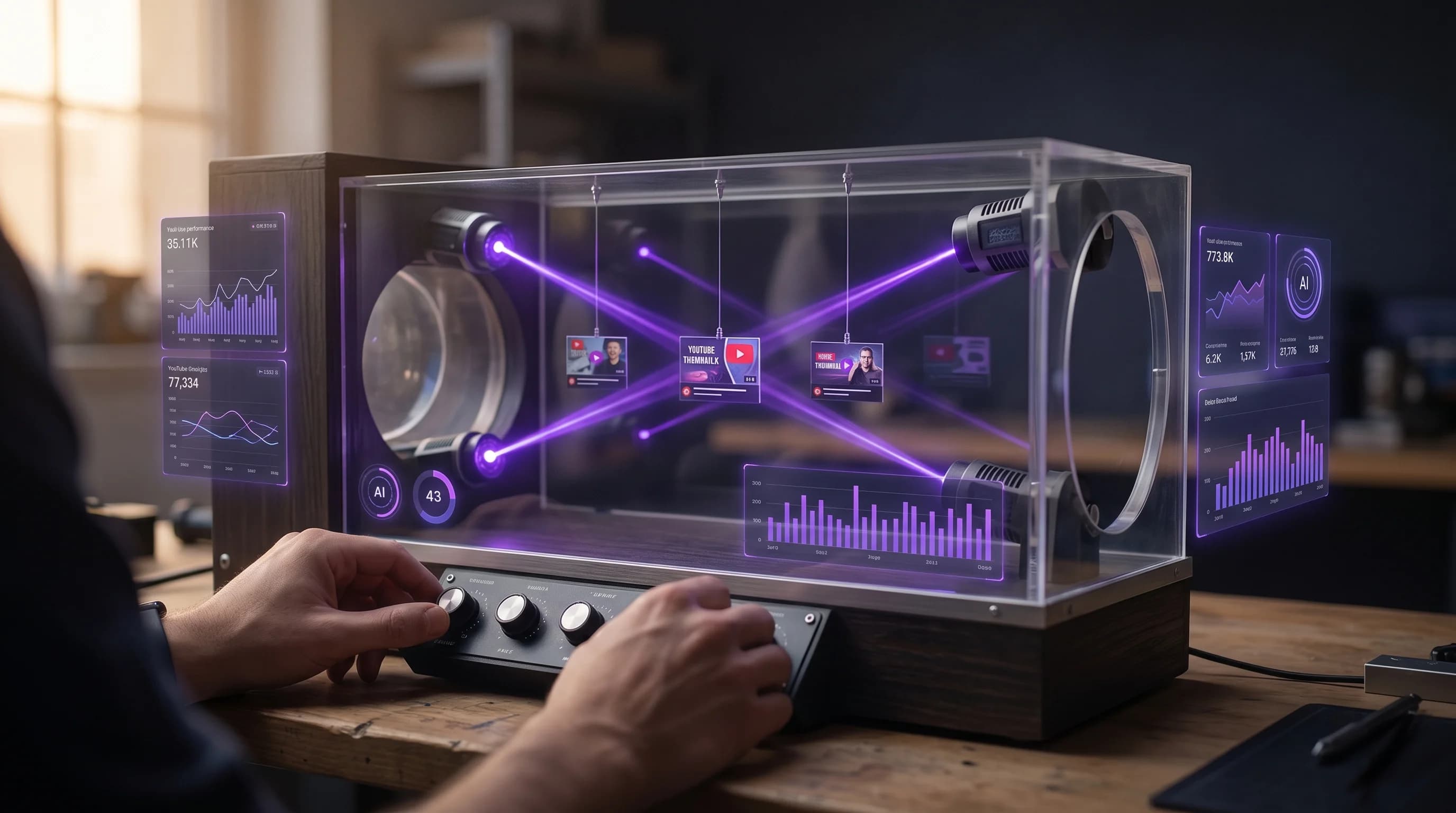
Test & Compare (3-Variant + Title Testing). The original Test & Compare feature tested two thumbnails. YouTube expanded it in early 2026 to support three thumbnail variants plus title testing — meaning you can test complete title-plus-thumbnail combinations. The winner is now determined by watch time share, not just CTR.
4K Thumbnails (50MB Upload Limit). YouTube raised the thumbnail file size cap from 2MB to 50MB in March 2026, supporting true 4K resolution at 3840x2160 pixels. The driver: TV usage on YouTube grew by 80% in 2025, and compressed thumbnails look rough on 65-inch screens.
These three features, used together, create a feedback loop that did not exist before. Ask Studio tells you what is working. Test & Compare lets you validate hypotheses. And 4K specs ensure your winner looks sharp everywhere it appears.
Why Watch Time Share Changes Everything
This is the most important shift, and most creators are missing it.
The old Test & Compare picked winners based on click-through rate. The expanded version uses watch time share — a metric that factors in not just whether viewers clicked, but whether they stayed.
YouTube's algorithm now evaluates what engineers call "Quality CTR." According to YouTube's creator education materials, a video with a 10% CTR followed by 80% of viewers leaving in the first 30 seconds is algorithmically worse than a 5% CTR where viewers watch 60% of the video. The platform interprets the first pattern as a thumbnail that overpromised relative to what the video delivered.
This has a concrete implication for thumbnail design: the winning thumbnail is no longer the most clickable one. It is the one that sets the most accurate expectation.
For the CTR benchmarks by niche in 2026, data aggregated by ThumbMentor and Humble&Brag shows:
- Gaming: 3-7% average CTR (high saturation, selective viewers)
- Tech/Reviews: 4-8% (spikes around product launches)
- Education: 4-6% (viewers seeking specific outcomes)
- Search traffic: 8-15% across all niches (intent-driven)
- Browse features: 3-7% (discovery-driven)
If your CTR falls within these ranges and your retention is above 50%, you are performing well. If your CTR is above these ranges but retention is below 40%, you may have a thumbnail accuracy problem — not a thumbnail quality problem.
The Four-Step Workflow
Here is the system I use now, combining all three tools into a repeatable process.
Step 1: Mine Your Analytics With Ask Studio
Before designing a single thumbnail, I open Ask Studio and run three prompts. These are not generic — they are designed to surface patterns that inform design decisions.
Prompt 1: "Which of my last 10 videos had the highest watch time share, and what did their thumbnails have in common?"
Ask Studio pulls up the performance data and highlights commonalities. You are looking for visual patterns — do your top performers use faces? Text overlays? Specific color palettes? The chatbot will not tell you design specifics, but it will point you to the videos you should study.
Prompt 2: "What are the most common themes in comments on my top 3 performing videos?"
Comment themes reveal what your audience actually values. If comments on your best-performing video all mention a specific takeaway, that takeaway should probably be visible in future thumbnails. YouTube's Ask Studio documentation confirms it can "analyse viewer comments to reveal the overall sentiment, highlight recurring themes, or provide ideas for future uploads."
Prompt 3: "How does my CTR compare between videos posted on weekdays versus weekends?"
Timing affects CTR in ways most creators do not measure. Ask Studio can surface these patterns quickly. If your weekend CTR is consistently 2 points higher, you might be designing thumbnails that work better for lean-back viewing — or your audience simply browses more on Saturdays.
The goal of this step is not to get definitive answers. It is to form two or three hypotheses about what is working. You will test those hypotheses in Step 3.
Step 2: Design Three Variants (Not Just Two)
The expansion to three variants is not just a numerical upgrade. It changes the testing strategy.
With two variants, you are running a binary test: does A or B work better? With three, you can test a hypothesis spectrum — three meaningfully different approaches to the same content.
Here is how I structure my three variants:
- Variant A — Safe baseline. Uses the patterns identified in Step 1. If faces perform well, Variant A has a face. If clean text overlays correlate with retention, Variant A has clean text.
- Variant B — Controlled deviation. Changes one element from the baseline. Same composition but different color palette, or same face angle but different text approach.
- Variant C — Creative risk. Tests an assumption you have not validated. A completely different visual approach, an unusual crop, or a contrarian design choice.
This structure ensures you are not just optimizing the thing you already know works. Variant C is where breakthroughs happen.
One practical note: if you are uploading 4K thumbnails (and you should be — more on this in Step 4), make sure all three variants are the same resolution. Mixing a 1280x720 variant with a 3840x2160 variant introduces a confounding variable. The sharper image may win not because of design choices but because it looks better on TV screens, which now account for a significant share of YouTube consumption.
Step 3: Run the Test With Watch Time Focus
Upload all three variants through Test & Compare. YouTube will split traffic and run the test for up to two weeks, depending on your impression volume.
Here is where most creators make a mistake: they check CTR during the test and make premature conclusions.
YouTube's Test & Compare determines the winner based on watch time share. A variant with slightly lower CTR but higher retention will often win — and that is the correct outcome. The algorithm is telling you which thumbnail sets the most accurate expectation.
According to Influencer Marketing Hub's analysis, channels with at least 1,000 impressions per day typically generate meaningful results within three to five days. Smaller channels may need the full two-week window.
What to do while the test runs:
- Do not change the title mid-test. It introduces a confounding variable.
- Do not promote the video asymmetrically on social media (sending traffic to a specific variant skews results).
- Check results in Analytics, not the Content tab. The Analytics page shows watch time share breakdown.
If there is no clear winner after two weeks, YouTube defaults to the first variant you uploaded. That is fine — it means the design differences were not significant enough to affect viewer behavior, which is itself useful data.
Step 4: Export Learnings and Upgrade to 4K
After the test concludes, go back to Ask Studio and ask: "How did my latest A/B test compare to my typical video performance?"
This closes the feedback loop. You are not just learning which variant won — you are learning whether the testing approach itself is improving your overall channel performance.
Then, take the winning design language and apply it to your 4K workflow.
The 50MB upload limit means you can now export thumbnails at 3840x2160 without quality loss. This matters more than most creators realize. YouTube's decision to increase the limit was driven by TV viewership growth — and the gap between a 1280x720 thumbnail and a 3840x2160 thumbnail is immediately visible on a large screen.
Practical specs for your 4K thumbnails:
- Resolution: 3840x2160 pixels (16:9 aspect ratio)
- Format: PNG for maximum quality, WebP if you need smaller files
- File size: Stay under 10MB for fast uploads, even though 50MB is the limit
- Desktop only: The 50MB limit applies to desktop uploads; mobile is still capped at 2MB
- Text sizing: If you use text overlays, they need to be legible at both 4K (TV) and 360p (mobile search). Test at both extremes.
What This Workflow Actually Produces
After running this process for a month across 8 videos, here is what I observed:
The combination of Ask Studio insights plus 3-variant testing produced a measurable improvement in consistency. Instead of guessing which thumbnail approach to use, I had data-backed starting points for each video. The testing validated or corrected those starting points.
The 4K upgrade had a more subtle effect. I did not see a CTR change from resolution alone — but I did see longer session times from TV viewers, which aligns with what data-driven analyses have found: videos with optimized thumbnails see an average 15-20% higher CTR, and AI-driven thumbnail analysis can increase click-through rates by over 30% for channels that systematically apply the findings.
The biggest win was not any single tool. It was the feedback loop. Ask Studio surfaces what is working, Test & Compare validates hypotheses, and the results feed back into the next round of Ask Studio queries. Each cycle gets tighter.
Common Mistakes to Avoid
Testing variants that are too similar. If your three thumbnails differ only in slight color shifts, the test will not produce a clear winner. Make Variant C meaningfully different — different composition, different visual hierarchy, different emotional tone.
Ignoring the watch time share metric. If you only look at CTR in your Test & Compare results, you are using a 2024 framework on a 2026 tool. Watch time share is the metric YouTube uses to pick the winner for a reason.
Overcomplicating Ask Studio prompts. The chatbot works best with specific, narrow questions. "Tell me about my channel" produces vague answers. "What is the average retention rate on my gaming tutorials published in the last 30 days?" produces actionable data.
Uploading mixed resolutions. If you test a 1080p thumbnail against a 4K thumbnail, resolution quality becomes a confounding variable. Keep resolution consistent across variants.
Skipping the feedback loop. Running one test is useful. Running five tests where each one builds on the learnings of the last is transformative. The workflow is designed to compound.
Where AI Thumbnail Tools Fit In
YouTube's native tools handle the analytics and testing side. They do not help with the design itself.
That is where external tools fill the gap. If you are designing three variants per video (which the workflow requires), the creative bottleneck shifts from "which thumbnail should I use?" to "how do I produce three quality thumbnails efficiently?"
Tools like Hooksnap generate multiple thumbnail variants from a single video, which maps directly to the 3-variant testing workflow. You get three starting points, customize each to represent your hypothesis spectrum (safe, deviation, creative risk), and upload all three to Test & Compare.
The key insight is that YouTube's AI tools and external generation tools are complementary, not competitive. YouTube tells you what works. External tools help you produce more of it, faster.
Stop guessing. Start testing thumbnails.
Paste any YouTube URL and get AI-branded thumbnails in under 60 seconds. Free to try.
Try Hooksnap FreeThe Shift From Intuition to System
The meta-change in 2026 is that YouTube has made data-driven thumbnail optimization accessible to every creator, not just channels with dedicated analytics teams.
Before Ask Studio, understanding your thumbnail performance meant exporting CSVs and building spreadsheets. Before 3-variant Test & Compare, A/B testing required third-party tools with monthly subscriptions. Before the 4K upgrade, creators on TV-heavy audiences had no way to serve sharp thumbnails.
These barriers are gone. The question is no longer whether you can optimize thumbnails systematically — it is whether you will.
The workflow is straightforward: mine your analytics for hypotheses, design three variants that test those hypotheses, let YouTube pick the winner based on watch time share, and feed the results back into your next round. Each cycle takes less time as you build intuition about what your specific audience responds to.
If you are currently uploading a single thumbnail per video and hoping for the best, you are leaving measurable performance on the table. The tools are free. The workflow takes an extra 20 minutes per video. And the compounding effect of systematic testing is the closest thing to a guaranteed growth lever on the platform right now.
Further Reading
- YouTube Thumbnail A/B Testing: A Complete Guide for 2026 — deep dive into testing methodology
- How to Read Your YouTube Analytics to Fix Your Thumbnails — analytics fundamentals
- YouTube Thumbnail Optimization in 2026: What the Data Actually Says — data-backed design principles
- Compare Hooksnap with other thumbnail tools — see how AI generation fits your workflow
- Hooksnap for creators — niche-specific thumbnail approaches
See how Hooksnap creates click-worthy thumbnails
AI-powered thumbnail generation that helps your YouTube videos get more clicks.
View PlansRelated Articles

What YouTube's Ask Studio Won't Tell You About Thumbnails
Ask Studio explains why a thumbnail underperformed — after the fact. It can't tell you which one to publish. Here's where YouTube's AI analyst stops.

Ask YouTube Is Here: What AI Search Means for Your Thumbnails
YouTube's Ask YouTube AI search from Google I/O 2026 reshapes video discovery. Here's what creators must change about thumbnails and content.

How YouTube's Gemini AI Actually Reads Your Thumbnail in 2026
YouTube now uses Gemini AI to analyze thumbnails via semantic IDs. Here's how the algorithm reads your thumbnail and what to change.
Related Tools
Ready to boost your CTR?
Stop losing clicks to boring thumbnails. Get AI-generated thumbnails in under 60 seconds.
Get Started Free