How to Read Your YouTube Retention Graph and Fix Every Drop-Off
Your YouTube retention graph tells you exactly where viewers leave. Learn to diagnose the 5 common retention curve patterns and apply targeted fixes that keep viewers watching longer.
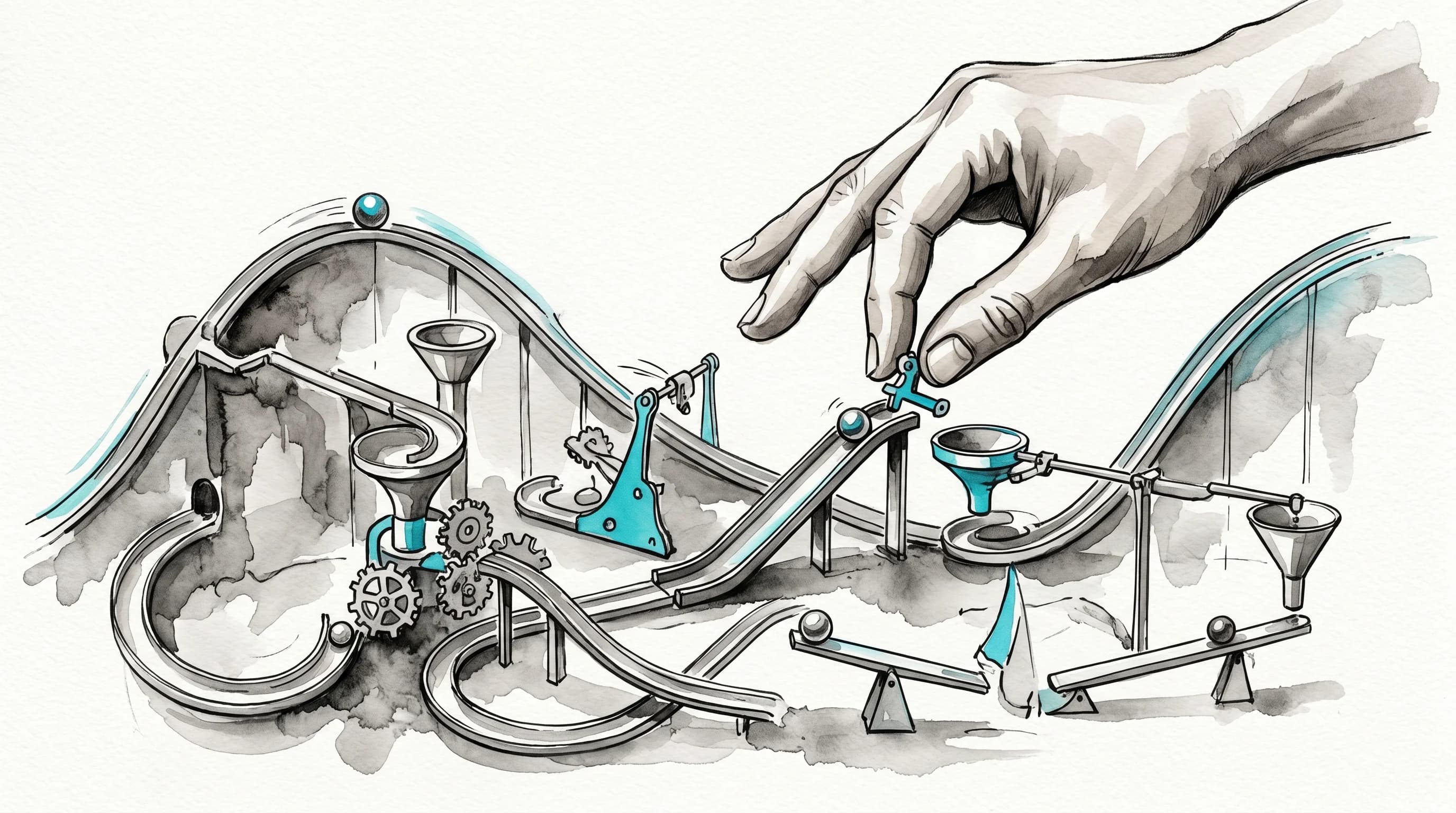
I spent last Tuesday staring at two retention graphs side by side. Both videos were from the same tech channel, same length, same topic cluster. One held 58% of viewers to the end. The other lost half its audience by the two-minute mark.
The difference wasn't the topic. It wasn't the thumbnail or the title. It was structure — specifically, where and how the creator placed their content beats. And the retention graph told the whole story, if you knew how to read it.
Most creators glance at their retention percentage, feel bad or good about the number, and move on. That's like a doctor checking your temperature and skipping the blood work. The retention graph is your video's diagnostic scan, and every dip, spike, and plateau is telling you something specific.
Here's how to actually use it.
What Your Retention Graph Is Really Showing You
Open YouTube Studio, click on any video, and navigate to the Analytics tab. Under the Engagement section, you'll find your audience retention graph — a blue line tracking the percentage of viewers still watching at every second of your video.
The horizontal axis is your video's timeline. The vertical axis is the percentage of your original viewers still present. A gray band behind your blue line shows your channel's average, so you can see whether each video is outperforming or underperforming your baseline.
But here's what most creators miss: the shape of the curve matters more than the final number.
According to Humble & Brag's 2026 benchmark study, the platform-wide average retention rate sits at roughly 23.7% across all video lengths. Only 1 in 6 videos (16.8%) surpasses the 50% retention mark. That means if you're holding half your audience through to the end, you're already outperforming the vast majority of content on the platform.
But averages are misleading without context. A 10-minute video with 45% retention is performing very differently from a 45-minute video at the same percentage. Video length changes the math entirely.
Retention Benchmarks That Actually Matter in 2026
Before diagnosing your curves, you need to know what "good" looks like for your content type. Here are the benchmarks that matter based on multiple 2026 analyses:
By video length:
- Under 5 minutes: 50-70% retention is healthy
- 5-15 minutes: 40-55% is solid, 55%+ is strong
- 15-30 minutes: 30-45% is healthy, 50%+ is exceptional
- Over 30 minutes: 25-35% is respectable for most niches
By content niche:
- Educational/how-to content: 42-60% average (highest performing category)
- Tech reviews: 35-50%
- Gaming: 25-40%
- Vlogs and entertainment: 21-35%
- Podcasts and talk formats: 25-40%
Here's the critical insight: YouTube's algorithm in 2026 weights average view duration at roughly 3x the importance of total views when deciding which videos to promote. Channels with 60%+ retention receive 4-5x more impressions than channels at the platform average. Retention isn't just a vanity metric — it directly controls your reach.
The 5 Retention Curve Patterns (And What Each One Means)
After reviewing hundreds of retention graphs across channels I advise and my own projects, I've found that almost every video falls into one of five patterns. Each one points to a specific structural problem with a specific fix.
Pattern 1: The Opening Cliff
What it looks like: A steep drop in the first 15-30 seconds, then a relatively flat or gradual decline for the rest of the video.
What it means: Your hook is failing. Viewers clicked because of your thumbnail and title, but your opening didn't deliver on that promise fast enough. YouTube Creator Academy data shows that over 33% of viewers leave within the first 30 seconds if the intro isn't engaging.
The fix:
- Cut your intro. No channel logos, no "hey guys welcome back," no context-setting preamble. Lead with the payoff.
- Mirror your title's promise in the first sentence. If the title says "5 ways to fix X," your first words should reference that specific problem.
- Show a preview of the result. If you're teaching something, flash the end result in the first 5 seconds, then rewind to show the process.
Benchmark target: If you're retaining 70%+ of viewers past the 30-second mark, your hook is working. Below 60%, your opening needs surgery.
Pattern 2: The Gradual Slide
What it looks like: A steady, consistent decline from start to finish — no dramatic drops, no spikes, just a slow downward slope.
What it means: This is actually the most common and generally the healthiest pattern. Your content is engaging but not creating moments of peak interest. The concern is when the slope is steeper than your niche benchmark.
The fix:
- If retention at the midpoint is above 40% for a 10-minute video, you're in solid shape. Focus on other metrics.
- If the slope is steep (losing more than 5% per minute), you need more structural variety — topic shifts, visual changes, or new information every 90 seconds.
- Add "open loops" — tease upcoming content early so viewers have a reason to stay. Phrases like "I'll show you the exact tool I use for this in a minute" create micro-commitments.
Pattern 3: The Mid-Video Cliff
What it looks like: Retention holds reasonably well for the first third, then suddenly drops 10-20% over a short span in the middle, before leveling out again.
What it means: Something specific in your middle section is causing a mass exit. Common culprits: a tangent that deviates from the main topic, an overly technical explanation, a sponsorship segment, or a section that repeats information viewers already know.
The fix:
- Identify the exact timestamp where the cliff starts. Watch those 30 seconds yourself and ask: "Would I keep watching here?"
- Place a pattern interrupt 5-10 seconds before the typical drop-off point. This can be a visual change (new camera angle, B-roll, text overlay), an audio shift (music change, sound effect), or a content surprise (unexpected example, contrary opinion).
- If the drop aligns with a sponsor segment, move it to a point where retention has already naturally leveled off, not during an engaging section.
Data from AIR Media-Tech's editing analysis shows that videos with pattern interrupts every 10-15 seconds achieve 2-5 percentage points higher average view duration than those with interrupts only every 30 seconds.
Pattern 4: The Rewind Spike
What it looks like: Certain points in your retention graph spike above 100%. These are moments where viewers are rewinding to rewatch a section.
What it means: This is actually a positive signal — viewers found something valuable enough to revisit. YouTube tracks this as a "key moment," and it signals high engagement. But it can also mean the content was confusing or too fast to process on first viewing.
The fix:
- Look at what content lives at those spike points. If it's a tutorial step, consider slowing down or adding on-screen text to reinforce the information.
- Replicate the content type that generated spikes in future videos. If a quick demonstration caused rewatches, do more demonstrations.
- Add chapters (timestamps) at these moments so viewers can find them easily — this also boosts your video's chance of appearing in Google search with key moment annotations.
Pattern 5: The End-of-Video Cliff
What it looks like: Retention drops sharply in the final 10-20% of the video, much steeper than the natural decline throughout the rest.
What it means: Viewers are recognizing that the valuable content has ended and the remaining time is likely an outro, call-to-action, or summary they don't need.
The fix:
- Cut your outro shorter. If your last 60 seconds are "Thanks for watching, like and subscribe," you're training viewers to leave early on every future video.
- Put your most important CTA (subscribe, next video link) before the content ends, not after. Embed it naturally in the final teaching moment.
- End abruptly. Seriously. Some of the highest-retention creators simply stop when the content is done, with no wrap-up at all. The algorithm doesn't penalize this — viewers leaving at 95% is far better than leaving at 80% because they see the outro coming.
The "Good Abandonment" Shift: Why Lower Retention Isn't Always Bad
YouTube's Gemini-powered algorithm introduced a concept in 2026 that changes how we think about retention: good abandonment.
Here's the idea: if someone watches 3 minutes of your 10-minute tutorial, finds exactly the answer they needed, and leaves YouTube satisfied — that's now a positive signal. The algorithm recognizes that the viewer's need was met. They don't search for the same topic again. They don't click a competing video. They got what they came for.
This means certain content types — tutorials, how-to guides, reference videos — may have naturally lower retention numbers that don't actually hurt your channel. The algorithm is sophisticated enough to distinguish between "this video was boring" and "this video solved my problem efficiently."
What does this mean practically? Don't pad your videos with filler to artificially increase watch time. A tight 6-minute video where viewers get what they need and leave satisfied will often outperform a bloated 15-minute video where viewers stick around but feel frustrated.
A Weekly Retention Audit (15 Minutes That Compound)
Reading retention graphs occasionally won't move the needle. Here's the system I recommend to every creator I work with:
Every week, after your latest video has 48 hours of data:
-
Open the retention graph. Note the overall percentage and the curve shape. Which of the 5 patterns does it match?
-
Find the single biggest drop-off. What timestamp does it start at? What content is playing at that exact moment?
-
Write down one structural change for your next video that addresses that drop-off. Just one — not five. One specific, testable change.
-
Compare against your last 5 videos. Is the same drop-off pattern recurring? If your retention always craters at the 2-minute mark, you have a systemic problem (probably your post-hook pacing) rather than a one-off issue.
-
Check for rewind spikes. These are your content gold. Whatever caused a rewatch moment should become a recurring format in future videos.
This 15-minute weekly ritual, done consistently, creates a compounding improvement loop. Each video gets slightly better at holding attention. Over 3-6 months, the difference is dramatic — I've seen channels increase their average retention by 15-20 percentage points using nothing but this systematic approach.
How Your Thumbnail Connects to Retention
Here's something that surprised me when I started correlating data: thumbnail design directly impacts retention, not just CTR.
A misleading thumbnail creates what I call a "false contract." The viewer clicks expecting one thing and gets another. The result is a steep opening cliff in your retention graph — your first 30 seconds become a mass exit as viewers realize the content doesn't match what the thumbnail promised.
The most effective thumbnails for retention aren't necessarily the highest-CTR ones. They're the ones that accurately represent the video's content while still being visually compelling. Your thumbnail is a promise, and your video's opening needs to fulfill that promise immediately.
This is actually why tools that generate thumbnails from your video content — rather than generic templates — tend to produce better retention outcomes. When your thumbnail is derived from what's actually in the video, the visual contract between click and content stays intact. At Hooksnap, we designed the entire pipeline around this principle: analyze the video first, then generate thumbnails that reflect what's actually inside.
If you're seeing a recurring opening cliff pattern in your retention graphs, audit your thumbnails before rewriting your intros. The problem might not be your hook — it might be that your thumbnail is setting the wrong expectation.
Retention vs. CTR: Stop Optimizing for the Wrong Metric
Many creators obsess over click-through rate because it feels like the gateway metric. More clicks equals more views, right?
Not exactly. We've covered the tension between CTR and viewer satisfaction before, but the retention angle adds another layer. A high CTR paired with terrible retention actually hurts your channel. YouTube interprets this as: "People are clicking, but immediately regretting it." That sends your video to the algorithm's penalty box.
The healthiest combination is a moderate-to-strong CTR (4-8% depending on your niche — check our CTR benchmarks by niche for specifics) paired with above-average retention for your video length. That combination tells YouTube: "People want to click this, and they like what they find."
If you're using A/B testing for your thumbnails, don't just pick the winner based on CTR alone. Cross-reference with the retention graph for each thumbnail variant. The thumbnail that produces slightly fewer clicks but much better retention will win the algorithmic race every time.
The Retention Feedback Loop With Title and Hook Design
Your retention graph also holds clues for improving your title and thumbnail synergy. When retention is strong through the first 60 seconds, your title-thumbnail-hook chain is working as one unit. When it breaks down, look for the disconnect:
- High CTR + low 30-second retention = Thumbnail and title set an expectation your video doesn't meet. Fix the opening or fix the promise.
- Low CTR + high retention = Your content is great but your packaging undersells it. Redesign your thumbnail and title to better represent the value inside. This is actually the easier problem to solve.
- Low CTR + low retention = Both the packaging and the content need work. Start with the content — no amount of thumbnail optimization will save a video people don't want to watch.
Start With Your Worst Video
Don't try to optimize everything at once. Go to YouTube Studio right now. Sort your recent videos by average view duration (lowest first). Pick the one video with the worst retention that you thought should have performed better.
Pull up its retention graph. Identify which of the five patterns it follows. Apply the targeted fix to your next video on a similar topic.
One video. One pattern. One fix. That's how retention improves — not through wholesale changes to your production process, but through systematic, graph-informed adjustments that compound over time.
And if your retention graphs are telling you the thumbnail is the problem — that your click-to-content contract is broken — Hooksnap can help you generate thumbnails that actually reflect what's in your video. Because the best retention strategy starts before the viewer even hits play.
Stop guessing. Start testing thumbnails.
Paste any YouTube URL and get AI-branded thumbnails in under 60 seconds. Free to try.
Try Hooksnap FreeFurther Reading
- How to Read Your YouTube Analytics to Fix Your Thumbnails — the CTR-focused companion to this retention guide
- YouTube's Satisfaction Algorithm: Why High CTR Hurts in 2026 — deep dive into satisfaction signals
- The YouTube Hook System: Thumbnail, Title, and First 30 Seconds — how the first moments connect to retention
- YouTube Thumbnail A/B Testing: A Complete Guide for 2026 — testing beyond CTR
See how Hooksnap creates click-worthy thumbnails
AI-powered thumbnail generation that helps your YouTube videos get more clicks.
View PlansRelated Articles

YouTube's Satisfaction Era: Your Thumbnail Is a Viewer Contract
YouTube's 2026 algorithm prioritizes viewer satisfaction over clicks. Here's how this shift turns your thumbnail into a contract you must deliver on fast.

Why a High CTR Can Kill Your YouTube Channel (And What to Do Instead)
YouTube's 2026 algorithm punishes high CTR paired with low retention. Learn how 'Quality CTR' works and how to design thumbnails that attract and keep viewers.

Your Thumbnail Is a Promise: Why the First 30 Seconds Matter
YouTube's 2026 algorithm punishes high CTR with low retention. Here is how to align your thumbnail with your intro so viewers stay past 30 seconds.
Related Tools
Ready to boost your CTR?
Stop losing clicks to boring thumbnails. Get AI-generated thumbnails in under 60 seconds.
Get Started Free